Sun exposure
How much sun will the condo
actually get?
“South-facing” on a listing says which way the windows point, not what reaches them. See the hours of direct sun on every side of a BC strata building, floor by floor, in winter, spring and summer, with the towers, trees and hills around it casting their shadows.
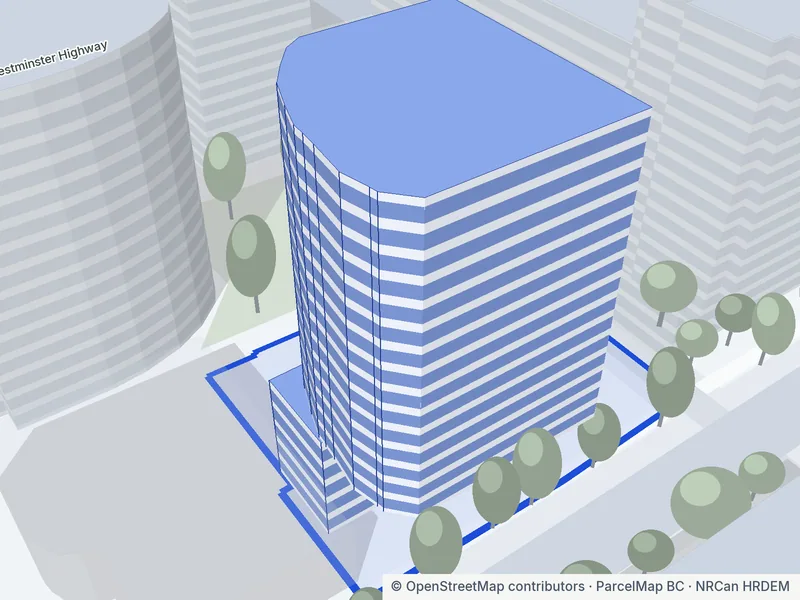
Paloma 2, 8033 Saba Rd, Richmond, December 21: floors 14–19 on the south side get about 7 hours of direct sun; floors 1–6, on the same side, get under an hour. The buildings around it take the rest.
Facing south is a start, not an answer
Three things decide how much sun a home gets. A listing tells you one of them.
Which way it faces
In BC the winter sun crosses the southern sky and never reaches a north wall. A south side can see it all day; east and west get half each.
How high it is
The same side of the same tower can get a full winter day of sun on its upper floors and none at its base, where the building across the street stands in the way.
What stands around it
Towers, mid-rises, tall trees and the slope of the land. A low December sun casts a shadow three times as long as the building that throws it.
What sun exposure shows
Hours of direct sun, side by side
Every side of the building by the way it faces, from north round to north-west.
Lower floors and upper floors
Worked out at a window in the middle of each, so you can see what the floors in between have to gain.
Three days that frame the year
December 21, March 20 and June 21, each against the hours of daylight that day.
Shadows at any time of day
Set the season and the time, or play the day from sunrise to sunset, and watch where the shadows fall.
Trees, in leaf or not
The main figure leaves trees out; switch them on to see the hours with every tree in full leaf.
The table for Paloma 2, 8033 Saba Rd, Richmond, as it appears in the 3D view
Direct sun, hours a day
| Side and floors | WinterDec 21 | SpringMar 20 | SummerJun 21 |
|---|---|---|---|
| Daylight | 8.2 | 12.2 | 16.2 |
| North side | |||
| Floors 14–19 | – | – | 4.1 |
| Floors 1–6 | – | – | 0.6 |
| East side | |||
| Floors 14–19 | 2.4 | 4.4 | 6.8 |
| Floors 1–6 | – | 1.5 | 1.7 |
| South side | |||
| Floors 14–19 | 7.1 | 11.0 | 8.2 |
| Floors 1–6 | 0.6 | 6.7 | 8.1 |
| West side | |||
| Floors 14–19 | 3.0 | 5.6 | 7.2 |
| Floors 1–6 | – | 1.0 | 2.5 |
| North-west side | |||
| Floors 14–19 | 0.6 | 3.8 | 5.3 |
| Floors 1–6 | 0.3 | 3.2 | 4.1 |
Worked out from this model: the sun's path on each day, shaded by the buildings and the lie of the ground in view. Each figure is the average along that side, at a window in the middle of those floors. Anything beyond about 300 m, a hill or a tower, casts no shadow here, and clouds are not counted.
How to use it
- 1
Find the building
Search any BC strata by address, building name or strata plan number.
- 2
Open Explore in 3D
Under the building's picture. The compass shows north; drag to turn the view.
- 3
Open Sun exposure
Pick winter, spring or summer, then drag the time or press play to run the day.
- 4
Read your side
Find the side your windows face and your floors in the table: hours of direct sun, each season.
Measured, not drawn
The buildings, trees and ground in each model come from Natural Resources Canada’s lidar survey wherever it covers the area, most of BC’s populated south. Lidar measures each roof and tree crown from the air to within a metre or two, so the tower across the street casts the shadow it really casts. The sun’s path is worked out for the building’s own latitude and longitude, every ten minutes from sunrise to sunset.
Common questions
Is a south-facing condo better?
For sun, usually. In BC the winter sun stays low in the southern sky, so a south side is the only one that can get sun through the middle of a December day: about 7 of the 8 hours of daylight in Vancouver, if nothing stands in the way. But a south-facing unit low down, across the street from a tower, can get none at all. Which way a unit faces tells you what is possible; what is around it decides what it gets.
Does a north-facing condo get any direct sun?
Not in winter: from late September to mid-March the sun never reaches a north wall in BC. In June it rises and sets far enough north to reach one early in the morning and late in the evening, typically for 3 to 6 hours. A north-facing unit gets steady, indirect light, which some buyers prefer for bedrooms and in hot summers.
Which direction should a condo face?
For winter sun, south, then south-west or south-east. West gets the afternoon and evening sun, and the heat that comes with it in summer. East gets the morning. North gets the least direct sun but the most even light. The right answer depends on how you live, but the hours each side actually gets, floor by floor, is what SearchStrata shows.
How do I find out which way a condo faces?
Open the building on SearchStrata and choose Explore in 3D: the compass shows north, and Sun exposure lists every side of the building by the way it faces. Listings use these terms loosely, so check the side your unit's main windows are on against the model rather than the description.
How are the hours worked out?
From the building's 3D model: the sun's path over its location on each day, every ten minutes, and whether anything in the model stands between the sun and a window on that side of the building. Building heights and trees are measured from Natural Resources Canada's lidar survey wherever it covers the area, and the ground's rise and fall is included. Each figure is the average along that side, at a window in the middle of those floors.
Are trees and clouds counted?
Trees are counted separately: the model can't tell an evergreen from a maple that loses its leaves, so the main figure leaves them out and a switch shows the hours with every tree in leaf. Clouds are not counted; the figures are direct sun on a clear day. A hill or tower more than about 300 m away is not in the model either.
Which buildings and plans include it?
Every strata building in BC with a 3D model on SearchStrata. Anyone can explore the 3D view; the sun exposure hours and the sun-and-shadow clock come with the full analysis of a building, on the Pro and Agent plans or with a single-building unlock.
Know the light before you buy
Sun exposure comes with the full analysis of a building, on the Pro and Agent plans or with a single-building unlock. The 3D view itself is free to explore.
Hours of direct sun on a clear day, worked out from a 3D model of the building and what stands within about 300 m of it. Not a survey or an inspection: a model can be out of date or miss a building, and clouds, blinds and balconies above are not counted. Check the unit itself before relying on it.
Building intelligence, in three parts
The building, the neighbourhood around it, and its own documents. The building is free and needs no account — its facts were already public.
1 · Free, no account
The building
What you’re buying into
Built of, year, storeys, homes, who manages it, what's been remediated. Assembled from land title, the assessment roll and strata filings. No account.
19,000+ BC corporations · $0
Search the record2 · Pro
The neighbourhood
What you can’t change
Nine areas past the lot line, measured from public BC data — transit, schools, hazard, crime, what's approved next door. Never in the building's own paperwork.
Location Insights · Pro
How Location Insights works3 · Upload
The documents
What you’re inheriting
The levies, the reserve fund, the litigation, the engineer's schedule — read out of this corporation's own package, each finding pointing at its page.
Your documents · deep analysis
See plans